



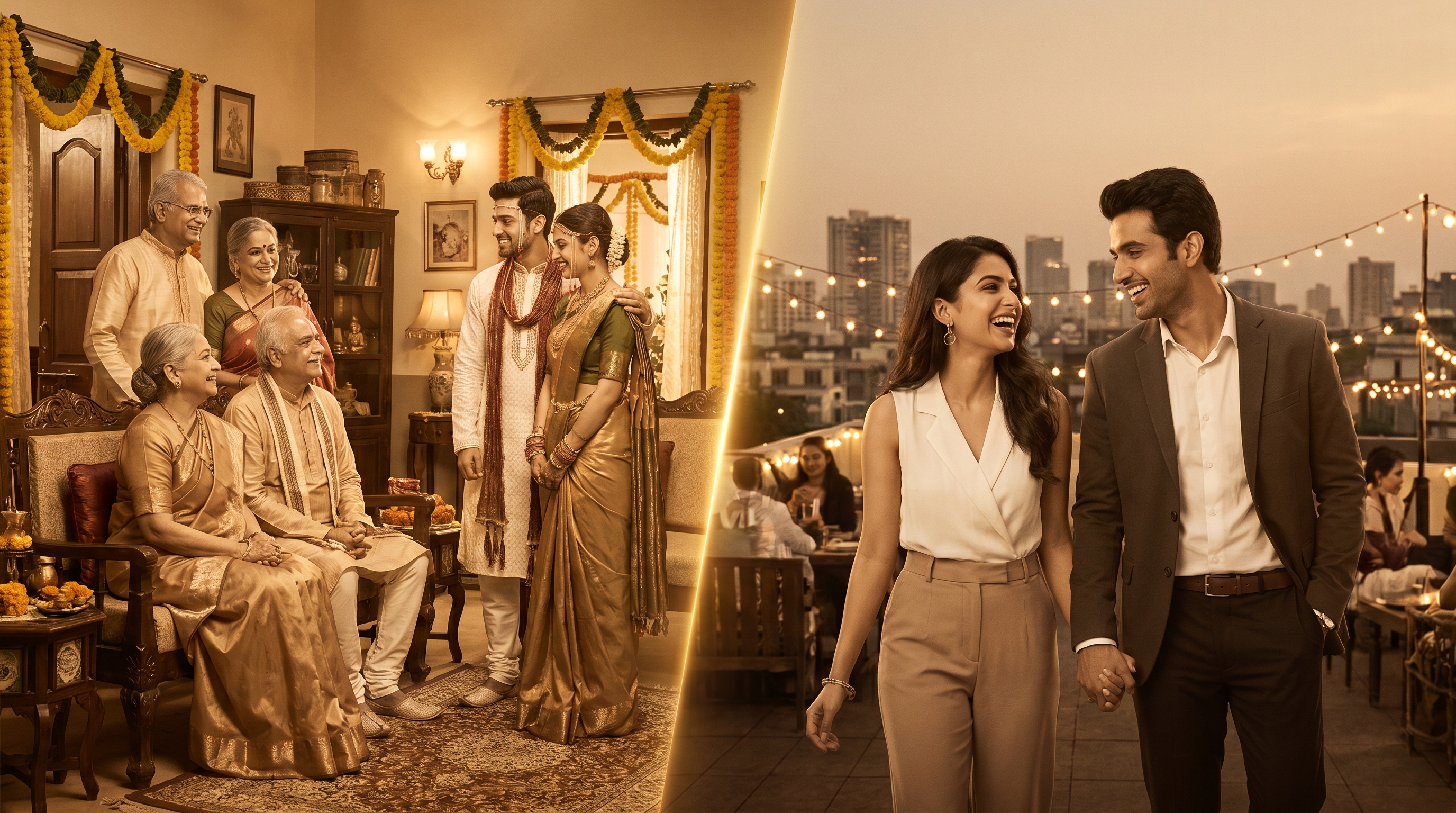
Arranged Marriage vs Love Marriage: An Honest, No-Nonsense Guide for 2026
By Pavitra Rishta | India's Premium Matchmaking Service Since 2006
You've probably been asked this question at a family gathering, debated it with friends over chai, or quietly wondered about it yourself -- arranged marriage or love marriage, which is actually better?
It's one of those conversations that never really ends. And honestly? It shouldn't. Because the answer isn't black and white. It never was.
At Pavitra Rishta, we've been helping families find meaningful matches for over 20 years. We've sat across the table from thousands of families -- Marwari, Jain, Gujarati, Punjabi, Maheshwari -- from Kolkata to California, from Delhi to Dubai. And what we've learned is this: the type of marriage matters far less than the people in it and the foundation it's built on.
But since you're here, let's have the honest conversation. No judgement, no agenda -- just real talk about both paths.
First, Let's Define What We're Actually Talking About
Love marriage is when two people meet, fall in love, decide they want to spend their lives together, and then (usually) bring their families into the picture.
Arranged marriage is when families -- or a matchmaker -- identify a compatible match based on values, background, community, and family compatibility. The couple then meets, gets to know each other, and decides whether they want to take it forward.
Notice something? In both cases, the couple ultimately decides. The myth that arranged marriages happen without the consent of the individuals involved is just that -- a myth. At least in today's India.
The more accurate term for what most families in India practise today is assisted marriage -- where families provide the structure and the initial introduction, but the individuals make the final call.
The Case for Love Marriage
You already know each other. When you choose to marry someone you've been with for months or years, you're not marrying a stranger. You've seen them on their worst days. You know how they handle stress, conflict, and disappointment. That's genuinely valuable.
Emotional compatibility is established. The initial connection, the shared experiences, the inside jokes -- all of it creates a foundation of genuine affection before the marriage even begins.
You've made an independent choice. There is something deeply empowering about choosing your own partner. You own that decision in a way that feels different when it was made entirely on your terms.
Breaking community barriers. Love marriages often happen across community lines -- a Punjabi marrying a Gujarati, or a Marwari marrying someone from a completely different background. For many couples, this cross-cultural mix has worked beautifully, broadening both their worldviews.
Modern relationships have changed. Today's couples meet at work, at universities, through social media, and at social events. The idea that you need a matchmaker or family involvement to find a partner feels outdated to many young Indians -- and that's a valid feeling.
The Case for Arranged Marriage
Family compatibility matters more than we admit. When you marry someone, you're not just marrying the individual -- you're entering their family. Shared values, similar socioeconomic backgrounds, aligned expectations about lifestyle, money, children, and responsibilities -- these things reduce friction significantly over time.
The statistics are telling. Studies consistently show that arranged marriages in India have significantly lower divorce rates compared to love marriages. In countries like the United States, divorce rates hover around 40-50% for love marriages. In India, where arranged marriage remains common, the overall divorce rate is under 1.1%.
No rose-tinted glasses. One underrated advantage of arranged marriages is that both individuals enter the relationship with realistic expectations. There is no idealized version of the other person to come crashing down. You're building love -- not trying to sustain a feeling of falling in love.
The family support system. In an arranged marriage, both families are invested from day one. This creates a powerful support system around the couple -- especially during difficult periods.
Deeper community roots. For Marwari, Jain, Gujarati, Punjabi and Maheshwari families, the value of marrying within the community goes beyond tradition. It's about shared cultural practices, religious observances, festivals, business networks, and a common understanding of life's priorities.
The Real Differences -- Broken Down
| Factor | Love Marriage | Arranged Marriage |
|---|---|---|
| Initial familiarity | High | Low to moderate |
| Family involvement | Lower initially | Higher from the start |
| Cultural compatibility | Variable | Usually strong |
| Emotional pressure | Lower (independent choice) | Can be higher (family expectations) |
| Support system | Depends on family acceptance | Usually strong from both sides |
| Divorce rate (India) | Higher relatively | Lower relatively |
| Time to build love | Before marriage | After marriage |
| Risk of idealising partner | Higher | Lower |
What Actually Makes a Marriage Work?
Here's the truth that neither camp wants to fully admit: the type of marriage -- arranged or love -- is far less important than what happens after the wedding.
Research by Dr. Robert Epstein, a Harvard-trained psychologist who has studied arranged marriages extensively, found that in arranged marriages, feelings of love are often stronger after 10 years than in love marriages. Not because arranged marriages are inherently superior -- but because couples in arranged marriages often approach the relationship with more intentionality.
- Mutual respect -- not just affection, but genuine regard for each other as individuals
- Aligned values -- on money, family, religion, children, lifestyle
- Open communication -- the ability to talk honestly, even when it's uncomfortable
- Shared sense of humour -- more important than people realise
- Family support -- having people around you who want the marriage to succeed
- Willingness to grow together -- neither person stays the same; the relationship must adapt
The Rise of the Third Path -- Assisted Matchmaking
What's fascinating about modern India is that a new model is quietly becoming the most popular: assisted matchmaking. It sits comfortably between the two extremes.
Think of it as the intelligence of arranged marriage combined with the agency of love marriage.
This is precisely what we do at Pavitra Rishta. When a client joins us, we don't just look at a checklist. Our Relationship Managers take the time to understand who you are -- beyond your biodata.
Take Rahul and Priya (names changed), a Marwari family from Kolkata. Rahul had been on several matrimonial sites for two years without success. The match we suggested -- a Jaipur-based family -- was one Rahul had initially dismissed on paper. But after meeting in person, he called us the next day: "This is different." They got married eight months later.
Common Myths -- Busted
Myth 1: Arranged marriages are forced marriages.
Completely false. Modern arranged marriages involve the full consent of both individuals. The family facilitates the introduction; the couple makes the decision.
Myth 2: Love marriages are always happier.
Not supported by research. Happiness in marriage correlates with compatibility, communication, and commitment -- not with how the couple met.
Myth 3: You can't fall in love in an arranged marriage.
Thousands of couples will tell you the opposite. Love that grows gradually, built on trust and shared experience, is often deeper than the love that arrives in a rush.
Myth 4: Arranged marriages are only for conservative families.
Wrong. We work with progressive, educated, well-travelled families across India and the world -- from New York to Singapore.
Myth 5: Online matrimonial sites are the same as matchmaking.
They are not. An online matrimonial site shows you profiles. A matchmaker understands you and curates introductions. The difference in outcomes is significant.
Questions to Ask Yourself
- Do we share the same core values?
- How do we handle disagreements?
- Do our families respect each other?
- Are we aligned on finances, children, and where we want to live?
- Do I feel genuinely comfortable being myself around this person?
- Can we communicate honestly without fear?
- Are we choosing this person -- or choosing to escape loneliness?
Our View -- After 20 Years of Matchmaking
Marriage is not a destination. It's a practice.
The couples who thrive -- whether they met at a college festival or through a matchmaker -- are the ones who choose each other every single day. Who communicate when it's hard. Who bring humility to conflict. Who remember why they started.
We don't use algorithms. We don't send you a list of profiles and wish you luck. We listen. We understand. And we make introductions that mean something. That's what Pavitra Rishta has always been about.
Final Thoughts
Arranged marriage vs love marriage is not a competition. It never was. Both paths can lead to extraordinary partnerships. Both can fail without the right foundations.
Pavitra Rishta Matchmaking Services LLP has been helping families across India and NRI communities find meaningful matches since 2006. We serve Marwari, Jain, Gujarati, Punjabi and Maheshwari communities across all cities in India and internationally in USA, UK, UAE, Canada, Australia, Singapore, Germany and Europe.
To know more, call us at +91 93303 22220 or visit pavitrarishtaindia.in